News
Why Garnet Sand the best abrasive for waterjet cutting
16/7/2026
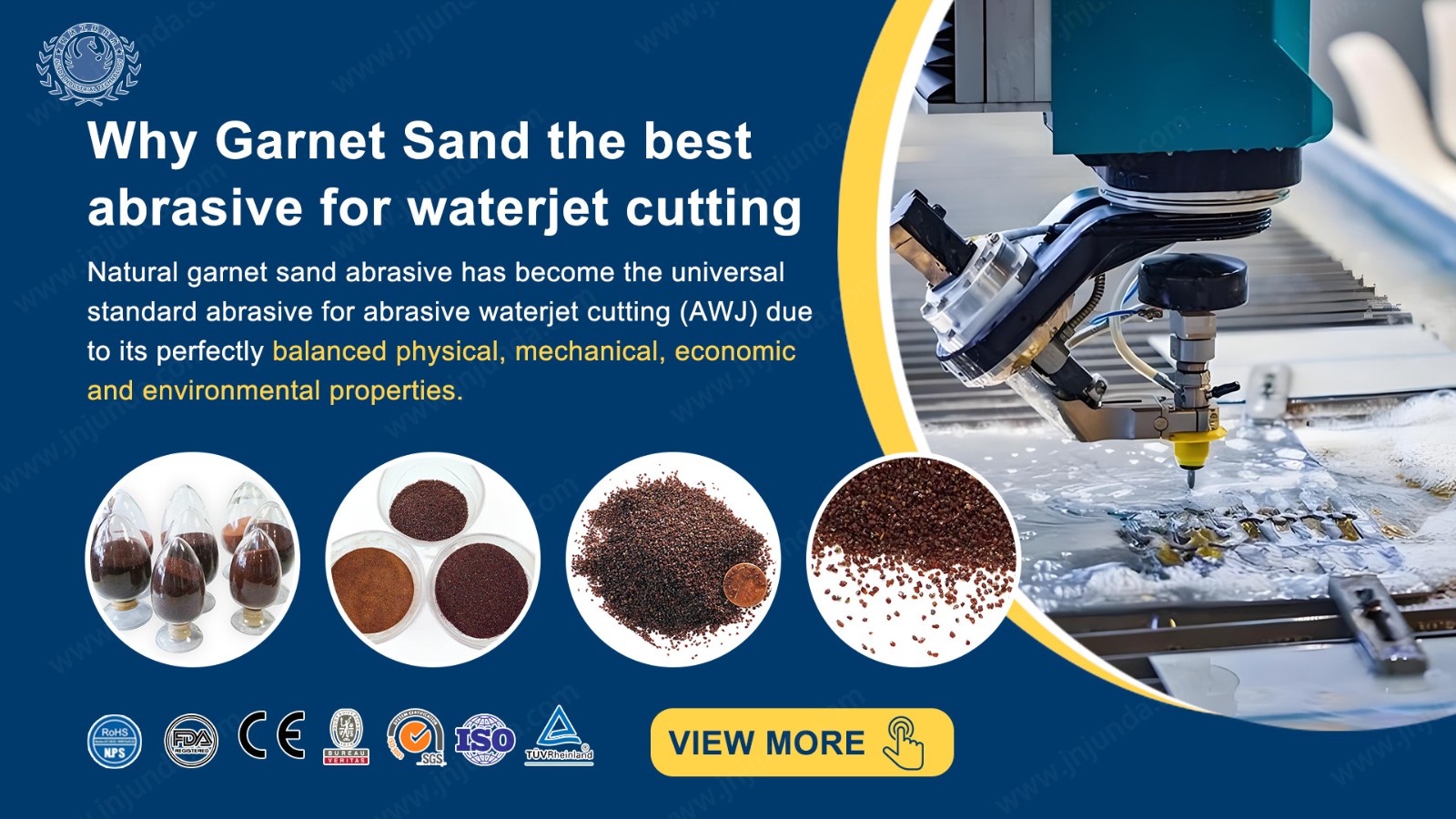
Natural garnet sand abrasive has become the universal standard abrasive for abrasive waterjet cutting (AWJ) due to its perfectly balanced physical, mechanical, economic and environmental properties that no alternative abrasive (aluminum oxide, silicon carbide, olivine, slag, glass bead) can match comprehensively Our Garnet Sand . Below is a full breakdown of its strengths:
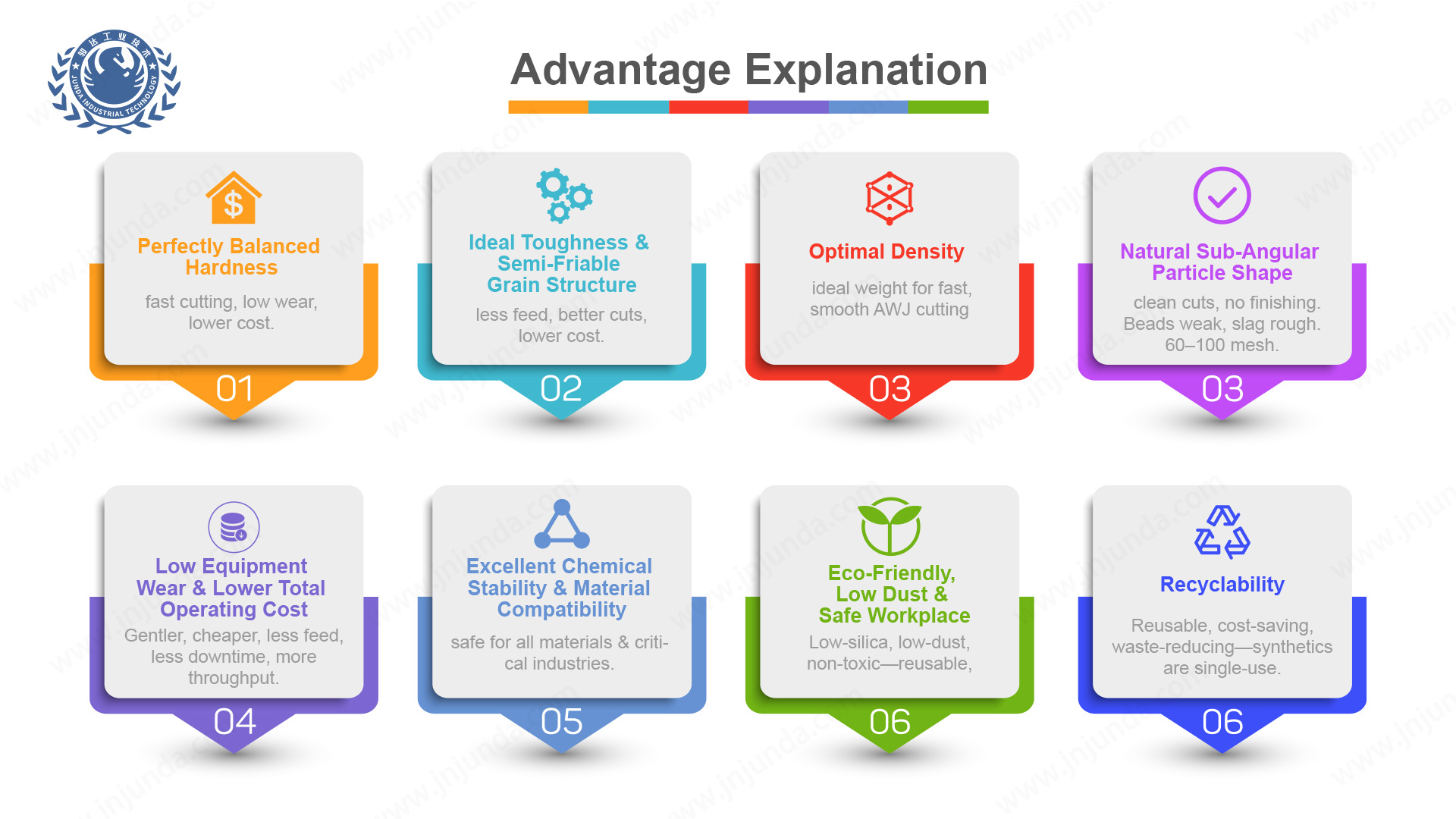
1. Perfectly Balanced Hardness (Mohs 7.5–8.5)
· Hard enough to cut stainless steel, carbon steel, aluminum, stone, glass, ceramic, composite and titanium efficiently; delivers fast material removal rates unlike soft abrasives (olivine, glass sand, slag) that cut slowly and waste water pressure .
· Not excessively hard like aluminum oxide (Al₂O₃) or silicon carbide (SiC). Superhard abrasives erode mixing tubes, focusing nozzles and cutting heads extremely fast—they can shorten nozzle service life by up to 90% vs garnet, raising high spare-part replacement costs
· Garnet hits the sweet spot: strong cutting power + moderate equipment wear to lower long-run machine maintenance expenses.
2. Ideal Toughness & Semi-Friable Grain Structure
· Garnet grains have moderate fracture resistance (semi-friable). When impacting workpieces at ultra-high pressure, grains crack along conchoidal fractures to continuously expose fresh sharp angular cutting edges throughout the jet stream.
· Soft abrasives pulverize into fine dust instantly after impact, losing cutting capacity quickly and requiring higher abrasive consumption.
· Over-tough abrasives stay intact with dull edges, resulting in rough, jagged cut surfaces with deep striations.
· Garnet maintains consistent cutting performance with less sand feed volume, saving abrasive cost per cut.
3. Optimal Density (~4.0 g/cm³)
Its density is exactly 4 times heavier than water, the ideal mass-to-volume ratio for AWJ systems
Heavy enough to gain sufficient kinetic energy when accelerated by high-pressure water jet to shear hard materials effectively.
· Not overly dense to fail mixing evenly in the water stream and cause uneven cutting or jet blockage. Low-density abrasives cannot transfer enough impact force, leading to slow cutting and rough edges.
4. Natural Sub-Angular Particle Shape for Superior Cut Quality
Pure garnet grains feature sharp, uneven sub-angular geometry:
· Produces ultra-smooth, burr-free cutting edges with minimal kerf width; secondary grinding/polishing is often unnecessary.
· Alternatives like round glass beads create only surface polishing without deep cutting power; slag abrasives generate heavy embedment and surface scratches on finished parts .
· Wide mesh range available (60# / 80# / 100#): coarse grit for thick metal/stone fast cutting, fine grit for precision thin plate, glass and intricate pattern cutting.
5. Low Equipment Wear & Lower Total Operating Cost
This is one of garnet’s biggest commercial advantages:
· Far slower erosion of critical consumables: mixing tubes, jewel nozzles, cutting heads, pumps and pipelines vs synthetic super hard abrasives.
· Lower abrasive consumption rate per unit cut material; natural garnet is cheaper per ton than aluminum oxide or silicon carbide.
· Less downtime for nozzle/tube replacement, boosting machine utilization and overall production throughput.
6. Excellent Chemical Stability & Wide Material Compatibility
· Chemically inert, non-reactive with all common cut materials (ferrous/non-ferrous metals, marble, granite, foam, carbon fiber, glass, rubber) and neutral in high-pressure water flow
· No chemical staining, oxidation or surface contamination on finished workpieces, critical for aerospace, food-grade and medical component cutting.
· Acid & alkali resistant, suitable for cutting special alloy and corrosive-resistant materials.
7. Eco-Friendly, Low Dust & Safe Workplace
· Naturally mined mineral with very low free silica, eliminating silicosis health risks that silica sand brings to operators.
· Produces far less fine airborne dust during cutting than slag, olivine or crushed stone abrasives, simplifying dust extraction and ventilation system loads.
· Non-toxic, heavy-metal-free waste; used garnet slurry can be recycled (re-screened for secondary cutting/blasting) or repurposed as aggregate filler for asphalt, concrete and construction materials without hazardous waste disposal fees.
8. Recyclability
Spent garnet slurry can be filtered, washed and reclassified for reuse in low-to-medium precision cutting or surface blasting, further reducing material cost and waste output—an unreachable benefit for disposable synthetic abrasives.
Quick Comparison vs Other Common Abrasives
Summary
Garnet sand outperforms all rivals because it balances cutting efficiency, surface precision, machine service life, running cost and environmental safety all at once—no other single abrasive can deliver this all-round performance, making it the dominant standard material for worldwide waterjet cutting workshops

professional firm engaged in the research, development, sale, and service of Steel Shot, Steel Grit, sandblaster, sandblasting machine, garnet sand. We are located in Jinan with convenient transportation access. .
Quick links
Products Structure
Our Contacts
Building A.B.C ,Ouyadaguan Commercial Capital, No.67 Yangguang Xin Road, Shizhong District,Jinan City, Shandong Province, China
0086-531-82020205
+0086-15806668333
- Message
- WhatsApp
-

Whastapp
-

Message